
Choosing a dentist involves more than finding the closest office. You are deciding who will look after your family’s teeth for the next decade, who you will call at nine o’clock on a Saturday when a crown comes loose, and whose treatment advice you will act on. In a town the size of Oakville, there are dozens of practices to pick from, and most of their websites say very similar things.
This guide is the checklist we wish every patient had before booking anywhere — the eight things that genuinely separate one family dentist in Oakville from another, how to check each one for yourself, and what our own answers are at Shoreline Dentistry in Bronte Village.
Why Choosing a Dentist in Oakville Is Harder Than It Looks
Nearly every practice describes itself as gentle, modern, and family-friendly. Those words are free, which makes them useless for comparison. What you actually want to know is narrower: is this dentist registered and in good standing, can they treat everyone in your household without sending you across town, what happens if you are anxious, and will you be told the cost before treatment rather than after?
Those questions have verifiable answers. The eight checks below are ordered roughly by how much they matter, starting with the one nobody thinks to do.
8 Things to Check Before You Book
1. Registration and good standing
Every dentist practising in Ontario must be registered with the Royal College of Dental Surgeons of Ontario. The register is public and searchable, so you can confirm in under a minute that the person treating you is licensed, see where and when they qualified, and check whether there are any findings against them. Look the name up on the RCDSO’s Find a Dentist register before your first appointment.
It is also worth knowing that in Ontario only dentists who have completed accredited specialty training may call themselves specialists — an orthodontist, a periodontist, a paediatric dentist and so on. A general dentist can perform many of the same treatments, and most do so routinely, but the titles are not interchangeable. If a practice describes itself using a specialty term, it is fair to ask which registered specialist is providing that care.
2. Whether one practice can treat every age
If you have a five-year-old, a teenager in aligners, and a parent who needs a denture adjusted, a practice that handles all three saves you an extraordinary amount of driving. Ask directly whether the practice sees children, and from what age. Ask whether they take on older patients with complex restorative needs.
The alternative is a family split across three offices with three sets of records, which is how small problems get missed between appointments.
3. How they handle nervous patients
Roughly one adult in five puts off dental care because of anxiety, and the practices that are genuinely good at this can tell you exactly what they do about it rather than simply saying they are gentle. Useful answers sound concrete: longer appointment times on request, a stop signal agreed before starting, numbing gel before the freezing, an explanation of each step as it happens, and the option of sedation for longer procedures.
If dental visits make you uneasy, say so when you book rather than on the day. Our guide to managing dental anxiety sets out the options we can offer.
4. Technology that actually changes your visit
Equipment lists are a weak signal on their own. What matters is whether a piece of technology changes something you would notice. Digital X-rays use a lower radiation dose than film and appear on screen immediately, so you can see what the dentist is describing. Digital scanning replaces the tray of impression putty for crowns and aligners, which most patients are relieved about. Intraoral cameras mean a recommendation comes with a photograph of the tooth rather than a description.
Ask what a given piece of equipment means for you specifically. A practice that can answer that has thought about it properly.
5. What gets referred out, and what is treated in-house
This is the question that most affects how your year actually goes. Every practice refers some cases onward, and a dentist who refers appropriately is being responsible, not limited. But the threshold varies a great deal, and each referral means a new waiting list, a new set of forms, and often a separate fee.
Ask plainly: are root canals done here, or referred? What about implants, wisdom teeth, and children’s treatment? The answers tell you how many separate offices you are likely to deal with over the next few years.
6. How treatment plans are explained
A good consultation leaves you able to explain the plan to someone else. That means hearing what the problem is, what happens if you do nothing for six months, what the options are including the cheaper and slower ones, and what each would cost. Being given a single recommendation and a total is not the same thing.
Watch for pressure to decide the same day on anything that is not an emergency. Genuine dental emergencies need acting on quickly; elective work does not.
7. Pricing transparency and coverage
Ontario has no fixed prices for dental treatment. The Ontario Dental Association publishes a suggested fee guide each year and practices set their own fees with reference to it, which is why two quotes for the same work can differ. You are entitled to a written estimate before treatment, and for anything substantial you should ask for one.
Also ask which coverage the practice works with. If you are enrolled in the Canadian Dental Care Plan, confirm the practice accepts it before booking, since participation is up to each provider. If you have no insurance at all, ask whether there is a membership or payment plan.
8. Location, hours and getting seen urgently
The most thorough practice in the region is the wrong choice if its hours mean you cannot get there. Check that the opening times fit around work and school, including at least one evening or weekend option. Check parking, since a mid-week appointment is much easier when you are not circling for twenty minutes.
Then ask the question people only think of later: what happens if something breaks or starts throbbing outside normal hours? A practice that reserves same-day slots for urgent problems is worth a great deal on the day you need one.

A Quick Checklist to Take With You
If you only ask a handful of questions when you call, make them these:
- Are you accepting new patients, and how soon could I be seen?
- Which ages do you treat, and do you see children?
- Are root canals, implants, and extractions done in-house or referred out?
- Will I get a written estimate before treatment starts?
- Do you accept the Canadian Dental Care Plan and direct-bill my insurance?
- What do you do for patients who are nervous?
- What are your evening and weekend hours?
- What should I do if I have a dental emergency after hours?
How Shoreline Dentistry Measures Up
It would be unhelpful to hand you eight questions and then dodge them, so here are our own answers.
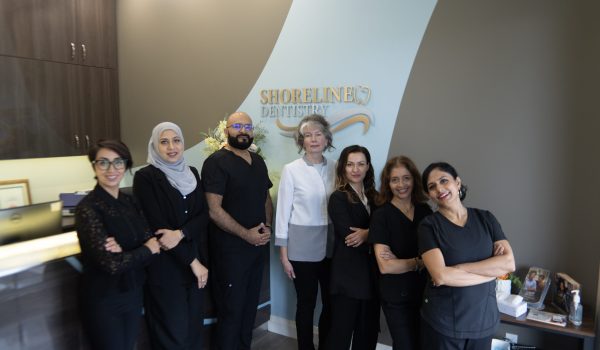
Our two dentists are both registered with the RCDSO, and you can look either of them up on the public register. Dr. Muzammil Zaidi, our lead dentist, earned his Doctor of Dental Surgery at Dalhousie University in 2005 after qualifying at Karachi University in 1998, and works as a general dentist with a particular interest in endodontics, prosthetic and cosmetic work, and oral cancer screening. Dr. Irina Kuslya earned her dental degree at the University of Toronto and has spent more than twenty years in private practice. You can meet the wider hygiene, denturist, and administrative team as well.
We treat every age in the household, from a child’s first visit through to full-mouth restorative work, and most treatment is completed here rather than referred elsewhere — including root canal treatment, dental implants, extractions and Invisalign. For anxious patients, we build in extra time, explain each step before it happens, and discuss sedation where a longer appointment calls for it. Every plan comes with a written, itemised estimate before we begin; we accept the Canadian Dental Care Plan and can direct-bill most insurers, and there is a membership plan for patients without coverage.
Dental Services Under One Roof in Oakville
Keeping treatment in one place is the practical benefit of a full-service practice: one set of records, one team who knows your history, and fewer referrals to chase.
- General dentistry — checkups, cleanings, fillings and oral cancer screening
- Cosmetic dentistry — whitening, veneers and smile makeovers
- Restorative dentistry — implants, crowns, bridges and dentures
- Invisalign clear aligners — discreet teeth straightening for teens and adults
- Children’s dentistry — checkups, fluoride, sealants and first visits
- Emergency dental care — prompt attention when something cannot wait
Between appointments, the routine is what protects your teeth: brushing twice daily, cleaning between them once a day, and a checkup at the interval your dentist recommends. The Canadian Dental Association’s oral health resources are a reliable, non-commercial place to read more.
What to Expect as a New Patient
Your first visit is mostly listening. We take a medical and dental history, ask what has bothered you in the past, carry out a thorough examination with digital X-rays where they are needed, and then talk through what we found and what the options are. You leave with a written plan and an estimate, and nothing is booked until you have decided.
If it has been a few years since your last appointment, that is a very common starting point and not something to apologise for. Our guide on what to expect at a first dental visit covers the appointment in more detail.

Visit Us in Bronte Village
We are at 11 Bronte Road, Unit 30, Oakville, ON L6L 0E1, in Bronte Village, with parking on site. Patients travel to us from Bronte Creek, West Oak Trails, Glen Abbey, Palermo, Kerr Village and Old Oakville, as well as neighbouring Burlington.
- Tuesday and Wednesday: 10:00 a.m. – 6:00 p.m.
- Thursday: 10:00 a.m. – 7:00 p.m.
- Friday: 10:00 a.m. – 6:00 p.m.
- Alternate Saturdays: 10:00 a.m. – 4:00 p.m.
- Closed Mondays and Sundays
To book, call 905-827-6453, email info@shoreline-dentistry.ca, or use our contact page. We are accepting new patients and happy to answer these questions on the phone before you commit to an appointment.
Frequently Asked Questions
How do I choose a family dentist in Oakville?
Start by confirming the dentist is registered and in good standing on the RCDSO public register. Then check the practical things: whether the practice treats every age in your household, how much treatment is done in-house rather than referred out, whether you will get a written estimate before treatment, which coverage they accept, and whether the hours and location genuinely work for you.
How can I check that a dentist in Ontario is licensed?
Search the Royal College of Dental Surgeons of Ontario’s public Find a Dentist register. It confirms registration and good standing, shows where and when the dentist qualified, and records any findings against them. It is free and takes about a minute.
What should I ask on a first phone call to a dental office?
Ask whether they are accepting new patients and how soon you could be seen, which ages they treat, whether root canals and implants are done in-house, whether you will get a written estimate before treatment, whether they accept the Canadian Dental Care Plan and direct-bill insurance, and what to do in an emergency after hours.
Is a family dentist the same as a paediatric dentist?
No. A paediatric dentist has completed accredited specialty training in treating children and holds that title on the RCDSO register. A family or general dentist treats patients of all ages, including children, as part of general practice. Both routinely care for children; only one is a protected specialty title.
How often should my family have a dental checkup?
Most people are seen every six months, but the right interval depends on your own risk of decay and gum disease, so it can reasonably be anywhere from three to twelve months. Your dentist should explain why they are recommending a particular interval for you rather than applying one rule to everyone.
Do you accept the Canadian Dental Care Plan?
Yes. Shoreline Dentistry accepts the Canadian Dental Care Plan. Participation is decided by each provider individually, so it is always worth confirming with any practice before booking. We can also direct-bill most private insurers and offer a membership plan for patients without coverage.
Where is Shoreline Dentistry located, and what are your hours?
We are at 11 Bronte Road, Unit 30, Oakville, ON L6L 0E1, in Bronte Village, with on-site parking. We are open Tuesday and Wednesday 10:00 a.m. to 6:00 p.m., Thursday 10:00 a.m. to 7:00 p.m., Friday 10:00 a.m. to 6:00 p.m., and alternate Saturdays 10:00 a.m. to 4:00 p.m. We are closed Mondays and Sundays. Call 905-827-6453 to book.
Are you accepting new patients?
Yes, we are accepting new patients of all ages, including children and families. Call 905-827-6453 or use our contact page to arrange a first appointment, and tell us when you book if dental visits make you anxious so we can plan the appointment accordingly.
Keep Reading